Can you play the organ with just one keyboard? (Spoiler: yes, and more often than you’d think!)

Updated: Jul 1, 2025

Ah, the organ… That majestic instrument with multiple keyboards, that sacred beast reigning over churches, mesmerizing us with its power. We always picture it with a forest of stops, dozens of registers, and a pedalboard that could give a fighter pilot cold sweats. But what if I told you that you can absolutely play the organ with just one keyboard? Yes, just one! And no, it’s not blasphemy.
The Organ: Multiple Keyboards… But Not Always Used
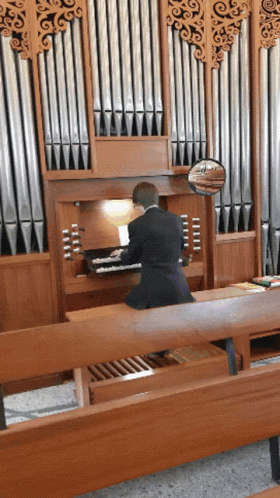
First, a quick refresher. Organs can have one, two, three, or even five keyboards, each allowing different sound combinations. And of course, there’s the pedalboard for the bass lines. But in reality—especially in liturgical practice—most pieces are played on a single keyboard. Yep, you read that right.
Why? Because during a church service, the organist spends most of their time accompanying—a choral piece, a hymn, a moment of meditation. And for that, there’s no need to juggle between multiple keyboards: one is enough to set the tone.
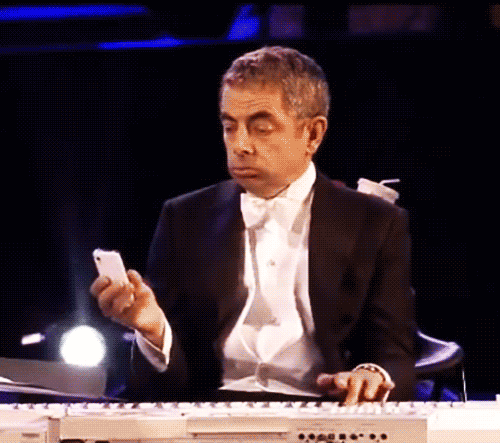
Of course, there are moments when the organ goes full throttle: the entrance, the exit, a grand, thunderous plein jeu. That’s when all keyboards are put to use, and the organist gets to have some fun. But in between those moments of grandeur, most of the work is done on a single keyboard.
A Rich Repertoire for a Single Keyboard
Basso Continuo: The Backbone of the Baroque
Let’s take a little trip back in time. In the Baroque era, playing on just one keyboard was standard practice. Most organists (and harpsichordists) improvised basso continuo, meaning a left-hand bass line and right-hand chords or embellishments. A huge part of the liturgical repertoire relied on this technique.

Bach, chorales & partitas
Even the great Johann Sebastian Bach, the undisputed master of the organ, wrote pieces specifically for a single keyboard. Take chorales BWV 767 and 768, along with their variations. These works are fully playable without ever touching the pedalboard or switching keyboards. Perfect for an organist working with a single manual!
César Franck’s L’Organiste: A Goldmine for a One-Keyboard Organ
If you’re looking for a repertoire specifically designed for an organ without pedals, César Franck has got you covered: L’Organiste (1890), a collection of 59 short pieces written for harmonium—entirely playable on a single keyboard.
Here are a few gems to check out:
Vieux Noël – A charming piece with folk-like accents.
Sortie – A bright, uplifting piece perfect for concluding a service.
Offertoire – Ideal for a moment of quiet reflection.
And that’s just the beginning!
Vierne, Widor… Even Messiaen?
Louis Vierne also wrote pieces in free style (Op. 31) that can be played without pedals and on a single keyboard. Even Charles-Marie Widor, known for his grand symphonies, composed more intimate movements that work just fine on a single manual.
And what about Messiaen? Well, that’s where things get trickier. His organ works are generally designed for an instrument with multiple keyboards and a pedalboard. However, some of his slower, more meditative pieces can be adapted to a single keyboard. It’s not about betraying the music—it’s about making it work!
Let's Adapt
Many organists—especially those playing on smaller instruments (such as positives or small village organs)—adapt pieces originally meant for multiple keyboards to a single manual.

For example:
A Bach fugue? You can rearrange some voices to fit within a single keyboard.
A dialogue between two manuals? Simply alternate forte and piano on the same keyboard to recreate the contrast.
A piece with a pedalboard? In some cases, the left hand can take over the pedal line (with a few adjustments, of course).
In fact, composers like Ferruccio Busoni adapted Bach’s organ works for piano. But let’s be honest—adapting an organ piece for one keyboard, only to play it on an organ, is kind of missing the point!
Especially since an organ keyboard usually has only 61 keys (five octaves), compared to a piano’s 88 keys (more than seven octaves). So adapting a piece designed for the vast soundscape of an organ to a single keyboard often means compromising its full expressive potential.
But when it’s time to go all out, we go all out!
Of course, when it’s time to shake the rafters, we don’t hold back. The entrance and exit of a service are the moments when the organist pulls out all the stops (literally):
Full-throttle Plein Jeu – Stacking stops across multiple keyboards.
Toccatas and Carillons – Perfect for showcasing the instrument’s full richness.
Iconic pieces:
Toccata from Widor’s Symphony No. 5
Carillon de Westminster by Vierne
Dieu parmi nous by Messiaen
At that point, limiting yourself to a single keyboard is out of the question—you use every resource the organ has to offer!

Conclusion: The One-Keyboard Organ – A Reality (And a Joy!)
So, can you play the organ with just one keyboard? Absolutely! Whether out of necessity (a small organ, harmonium, or positive organ) or by choice (selecting the right repertoire), there’s plenty of music written for a single keyboard. Liturgical practice itself largely relies on this configuration.
But when the occasion arises… the organist won’t hesitate to open everything up and let the instrument roar in all its glory!
🎵 Some links to organ pieces playable on a single keyboard:
Sheet music: IMSLP Virtual organ: organova.music
JS Bach – Choral BWV 767 - https://www.youtube.com/watch?v=aMSJvwf6QSs
JS Bach – Choral BWV 768 (choral + variations 1-6) - https://www.youtube.com/watch?v=gierj0nKCF8
JS Bach - Toccata for Harpichord BWV 914
JS Bach Various easy Bach Chorales : BWV 244/10; 2/6, 244/62, 441, 140/7, 56/5, 1122, 70/7, 363, 401, 409a, 145/5, 325, 416, 20/7, 337, 40/6, 285; 412, 4/8, 306, 159/5, 418, 87/7, 255, 153) https://www.youtube.com/watch?v=svWYhwKB5WE (from bachscholar.com)
Froberger - Canzona in G minor - https://www.youtube.com/watch?v=37K4iIevsc8
Pachelbel - Fuge F Major - https://www.youtube.com/watch?v=evtuUiRJxWA
César Franck - L'Organiste FWV 41 (1890): Sorties, Offertoires, Vieux Noëls
Vieux Noël 51 G minor : https://www.youtube.com/watch?v=egNPRQUqpzc
Vieux Nooël 4 D minor : https://www.youtube.com/watch?v=V41XlUUd_fk
Sortie en F major: https://www.youtube.com/watch?v=BxuLdvLFFJ4
Intégrale: https://www.youtube.com/watch?v=BxuLdvLFFJ4


Comments