From Piano to Pipe Organ: A Practical Guide for Beginners

Introduction
You heard Bach's Toccata and Fugue in D minor and thought, "wow, I want to try that." Or you watched Interstellar and were captivated by that monumental cathedral organ sound.
Then reality hits: pipe organs are massive instruments, inaccessible at home. Access to a church organ is rare, often constrained by strict schedules.
As for traditional virtual organ software, it often requires downloading heavy programs, configuring complex audio drivers, and wrestling with technical interfaces before you've even played a single note.
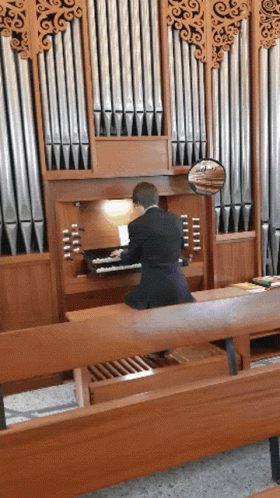
Then reality hits: pipe organs are massive instruments, inaccessible at home. Access to a church organ is rare, often constrained by strict schedules.
As for traditional virtual organ software, it often requires downloading heavy programs, configuring complex audio drivers, and wrestling with technical interfaces before you've even played a single note.
The main obstacle isn't talent. It's access.
The good news? You can start today. You already have piano technique. You have a MIDI keyboard. And thanks to modern browser-based virtual organs, you can experience authentic pipe organ sound in seconds—without installation, without expense, without commitment.
This guide walks you through the piano-to-organ transition, prepares you for the major technical differences, and shows you how to start practising right now.`
The 3 Biggest Shocks for Pianists Learning Organ
Shock 1: No Sustain Pedal – You ARE The Sustain Pedal!
On piano, you control resonance with the pedal. Press it, and sound persists even after your fingers leave the keys. On organ, the moment you lift your finger, the sound stops. Instantly. This requires a complete rewiring of your musical articulation.
The skill to develop: finger legato and substitution. To play a sustained melodic line without overlapping notes, organists use "finger legato"—moving your finger to the next key precisely as you lift the other, creating smooth transitions without the pedal's help.
Or they use substitution: hold a chord with one finger configuration, then discreetly replace a finger on the same key to free your hand for the next phrase.
It's not about speed, but about listening. You must hear the exact moment your finger should leave one key and arrive at the next to maintain the illusion of a continuous line. It's far more demanding than piano technique in this respect.
Shock 2: Volume Doesn't Come From Force—It Comes From What You Choose
On piano, dynamics are intuitive: hit harder = louder, light touch = softer. Your velocity (how fast you press the key) controls volume.
Pipe organs are not velocity-sensitive. Each key press triggers identical air pressure. A soft press and a firm press produce the same volume.
So how do organists shape the music?
Expression comes from registration (choosing which stops) and timing.
Want a passage to sound louder? Add a brighter stop or higher-pitched flute. Want it softer? Remove stops or choose gentler registrations. On a digital organ, you might have an expression pedal, but fundamentally, sound is determined by which pipes are open, not by your force.
This radically changes how you listen and conceive phrasing.
Shock 3: Articulation Is Your Primary Tool – And It's Temporal, Not Physical
Here's the subtle but crucial difference that surprises most pianists:
On piano: articulation is shaped by touch dynamics. You vary force, pedal release, attack. Your force is the tool.
On organ: articulation is shaped by the exact duration of each note and the space (silence) between notes. Your timing is the tool.
Because the organ sustains sound without your effort, managing silence becomes critical. A Bach chorale played with notes bleeding into each other will sound muddy. The same chorale, played with precise durations and tiny articulate silences between phrases, sings with clarity and elegance.
On piano, mediocre articulation can pass unnoticed if your dynamics are rich. On organ, it's immediately obvious.
This is why organ music demands such discipline. And once this skill is acquired, your musicality improves on all instruments.
How to Practise Without a Church Organ !
You might think: "I'll practise on my piano at home, then move to a real organ later."
This doesn't work well, for one simple reason: piano is percussive, organ is sustained.
On piano, your ear adapts to percussive attacks and rapid decay. You develop reflexes around velocity and pedal use. When you finally sit at a real organ, that sustained sound ruthlessly exposes every sloppy articulation and every piano habit that destroys organ music.
It's like learning to sing by shouting. The instrument is too different.
The Modern Solution: Virtual Organs
Technology has changed the game. You can now practise authentic organ music at home. Two approaches exist:
1. Full Simulators (e.g., Hauptwerk / Grand Orgue / Sweelinq / jOrgan)
The reference for permanent installations. Incredible authenticity, hundreds of sampled organs, deep customization.
The drawback: they require a powerful dedicated computer, complex audio configuration, and substantial setup time. Ideal for committed organists building a permanent console.
2. Browser-Based Organ (e.g., Organova)
The newer approach, focused on accessibility. It runs directly in your web browser—no installation, no technical configuration. Though lighter, they offer high-quality sampled instruments.
The advantage: the ideal starting point for a pianist. Plug in your keyboard, open a tab, and start playing immediately with authentic sound.
First Steps: 3 Exercises to Do Right Now
For more depth, we recommend watching a registration tutorial (e.g., "How To Register An Organ" by Richard McVeigh).
Exercise 1: Registration Discovery – Sound Is What You CHOOSE
Why: On piano, you change tone by touch. On organ, it's stop selection that decides. This is the major revelation for any pianist.
The exercise:
Take a simple melody (e.g., a folk tune or chorale).
Play it with only a Principal 8' (the warm, basic sound).
Add a Flute 4' (brighter, higher—one octave above). Notice how the character changes completely: neither louder nor softer, just differently textured.
Add a Mixture or 2' stop (two octaves higher). The melodic intensity transforms again.
Realize your physical touch remained identical, but the musical character changed completely. This is the fundamental insight: on organ, sound depends on your choice of stops, not your playing.
Exercise 2: The "Glue" Exercise – Finger Legato
Why: Without a sustain pedal, your fingers must connect each note to create the illusion of a continuous line. This is THE key technical skill for the transition.
The exercise:
Choose a Principal 8' registration.
Play a C major scale—slowly, one note per second.
Goal: each note must sound perfectly connected. No silence between them, no overlap (blur).
Imagine your fingers are glued to the keys: one finger lifts only at the exact millisecond the next one strikes.
Listen carefully. At first, you'll likely have overlaps or gaps. Adjust your timing until it's perfectly smooth.
Practise this 5 minutes daily. This exercise alone develops the articulation discipline that distinguishes amateurs from intermediate organists.
Exercise 3: The Articulation Study – Timing as Expression
Why: Since you can't play "louder" by hitting harder, you must play "longer" or "shorter" to create accents. Articulation timing is your primary expressive tool.
The exercise:
Take a simple 4-bar phrase (a Bach chorale or familiar melody).
Version 1 (Legato): Play each note with maximum length. Tiny spaces between them. The line should sing as one voice.
Version 2 (Detached): Play the same phrase, but shorten each note by half. Each note distinct, separated by clear silence.
Version 3 (Staccato): Short, crisp notes, almost bouncy.
Listen to how the emotional character of the same notes changes radically based only on when you release each key. This is the epiphany: on organ, emotion comes from temporal articulation, not force.
Your Home Setup (The "Simple Rig")
You don't need much to start.
The minimum:
A MIDI keyboard (49 or 61 keys are fine; 88 keys are comfortable but not essential).
A computer (laptop or desktop) with a web browser.
Organova (free beta).
That's it. Plug in, open the browser, play.
After a few months (optional):
A MIDI pedalboard (€300–€800) to work on pedal technique.
A second keyboard to simulate two organ manuals (left hand on Swell, right hand on Great Organ). But this isn't necessary for the first 6 months.
Why this matters: Don't wait for perfect equipment. Starting now with a simple setup is better than waiting 6 months to afford a complex console. The fundamentals of articulation and registration are learned on any keyboard.
Begin with "Manuals Only" Pieces
Pedals can intimidate. Start with music written for hands alone:
J.S. Bach – Preludes and Fugues: Bach's "learning" pieces. Simple, beautiful, and approachable.
Bach Chorales: Any chorale can be played on manuals alone. Slow, contemplative, ideal for working on articulation.
Pachelbel – Canon (arranged for organ): Soothing and repetitive, perfect for developing your touch.
Have a look at: Can you play the organ with just one keyboard? (Spoiler: yes, and more often than you’d think!)
Progress to Pedal Pieces (When Ready)
Once comfortable with hands, add pieces with a simple pedal line:
Bach – Prelude and Fugue in E minor, BWV 548: The prelude has an accessible pedal part.
Buxtehude – Short toccatas: Beautiful, Baroque, without excessive complexity.
Simple Improvisation
The most underrated learning tool. Take a simple chorale tune. Play the melody in your right hand on a bright stop, and bass in your left. Let yourself play for 10 minutes, experimenting with articulation and registration. This trains your ear and instincts better than reading alone.
Conclusion: A Transition That Makes You a Better Musician
Moving from piano to organ isn't a horizontal shift—it's an upgrade to your overall musicality.
Piano teaches you touch and dynamic nuance. Organ teaches you voice independence, active listening, and temporal precision. Organists learn to think in sustained polyphony rather than percussive attacks.
Once you master these skills, you return to piano as a far more complete and sophisticated musician.

Ready to Start?
You have everything you need:
A MIDI keyboard (you probably already own one).
5 minutes to try the registration exercise and the "glue" exercise.
Organova open in a tab—no installation, no technical complications.
Take your keyboard. Open Organova. Play your first Bach chorale with authentic sound from a Swedish concert organ.
And come back and tell us: has the organ changed how you listen to music?


Comments